This is a review of the best pocket camera ever made.
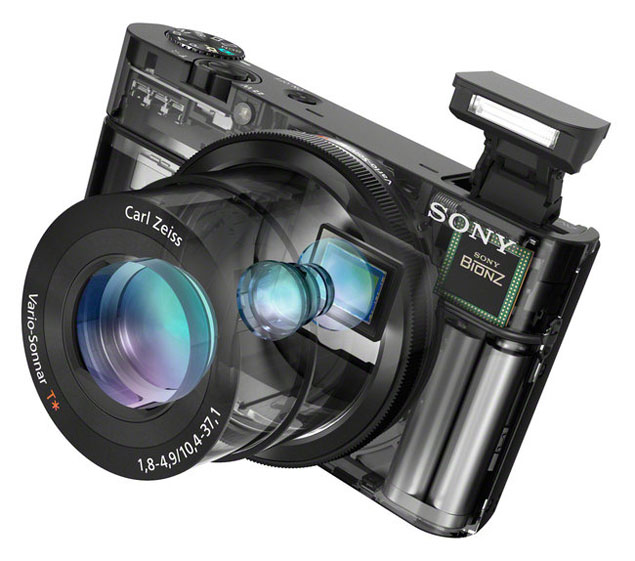
The Sony RX100 has a huge one-inch sensor - the biggest ever stuffed into a pocketable zoom camera
But first, a history lesson.
For years camera makers worried about competition from only one source: other camera makers. But in the end, the most dangerous predator came from an unexpected direction: cellphones.
Today, more photos are taken with phones than with point-and-shoot cameras. On photo sites like Flickr, the iPhone is the source of more photos than any real camera. No wonder sales of inexpensive pocket cameras are going down each year.
Cameras in phones are a delightful development for the masses. If you have your camera with you, you're more likely to take photos and more likely to capture amazing images.
But in a sense they are also great for camera makers, which are being forced to double down in areas where smartphones are useless: Zoom lenses. High resolution. Better photo quality. Flexibility and advanced features. That's why, even if sales of pocket cameras are down, sales of high-end cameras are up.
Now you know why the time is ripe for the new Sony Cyber-shot DSC-RX100. It's a tiny, pants-pocketable camera that will be available in late July for the nosebleed price of $650.
Or, rather, won't be available. It will be sold out everywhere. I'll skip to the punch line: No photos this good have ever come from a camera this small.
The first reason is easy to grasp. The Sony RX100 has a huge one-inch sensor - the biggest ever stuffed into a pocketable zoom camera. That's not as big as the sensors in S.L.R.'s and other lens-swappable cameras. But it's about four times the area of the previous pocket-camera photo-quality champs, like the Olympus XZ-1 and the S100. (The RX100's shiny black metal body looks exactly like them.)
A big sensor means big pixels, which gives you less grain in low light, better color depth and great dynamic range - the spectrum from darkest to lightest pixels.
A big sensor is also a prerequisite for that professional blurry background look. The RX100 easily achieves those soft backgrounds, a rarity in compact cameras.
The other star factor in the Sony is its Carl Zeiss lens, whose maximum aperture (lens opening) is f/1.8. That's the widest aperture you can buy on a pocket camera. That, too, helps explain its ability to blur the background, and its spectacular results in low light.
(As on any camera, that aperture shrinks as you zoom in. When you're fully zoomed on this camera, you're down to f/4.9. That's still better than the Canon's fully zoomed aperture - f/5.9.)
But you know what? All of that is just shutterbug-speak for, "This camera takes amazing photos." If you want to know what "huge sensor" and "big aperture" mean in the real world, stop reading and savor my annotated slide show of sample photos. There's a small sampling at nytimes.com/personaltech, and a larger one at http://j.mp/LdUu4h.
There you'll see what makes the RX100 such a revelation: insane amounts of detail and vivid, true colors. Hand-held twilight photos. A burst mode that can fire 10 frames a second. And macro shots - supercloseup - that will curl whatever's left of your hair. A typical S.L.R. can't get any closer than 10 inches from the subject with its included lens; the RX100 can nail focus only 2 inches away.
The RX100 is as customizable and manually controllable as an S.L.R., but it also has some impressive automated modes. They include Illustration (turns the photo into a colorful line drawing), High Dynamic Range Painting and the bizarre but sometimes enlightening Auto Crop. It creates a duplicate of your portrait, cropped in what it considers a better way. Sometimes, it's right.
And Sweep Panorama. You swing the camera around you in an arc, pressing the shutter button the whole time. When you stop, there, on your screen, is a finished, seamless, 220-degree panorama. It's the ultimate wide-angle lens. Canyons, crowd shots, Walmart interiors - you won't believe how often it's useful.
For self-portraits, you can set a timer as usual. Or use its even smarter mode, in which the camera waits until it sees your face in the frame. Then it fires a shot every three seconds until you leave the scene.
As usual on today's compacts, there's no eyepiece viewfinder, a loss you may mourn. But the three-inch screen remains clear and bright even in bright sunshine, thanks to an extra white pixel Sony has nestled in among every set of red, green and blue.
The 1080p video capture isn't quite the same festival of crispness as the photos. But you can use all the photo effects while filming. And while recording, you can zoom, change focus and even take still photos.
Sony has taken the debatable step of bringing back in-camera charging. That is, there's no external charger for the 330-shot battery. Instead, the camera is the charger, whenever it's connected to a USB jack, like the one on your laptop, or a wall outlet. Pros: No charger to pack and lose. Cons: You can't charge a spare battery while you're out shooting.
As with its role model, the Canon S100, you can program the function of the Sony lens ring. It can control zoom, focus, exposure, aperture, whatever. But unlike the Canon's ring, the Sony's ring doesn't click as you turn it - sounds that get picked up when you're capturing video.
On the hand, you don't feel clicks either. The ring spins freely, which gives it a glassy, skidding feeling when you're adjusting a setting with natural stopping points, like ISO (light sensitivity) or shutter speed.
That's not the only niggling downside. The biggest one, of course, is that there's very little room for physical buttons. All of the RX100's hundreds of functions are packed into five buttons on the back, a mode dial on top, the ring around the lens and a four-way clickable ring on the back.
Novices will find it overwhelming. Then again, it's fairly clear that this isn't a camera for novices. Besides, eventually it all makes sense. You learn to press the Fn button whenever you want to adjust a photographic setting, or the Menu button to adjust a camera-setup setting.
The camera has a 3.6X zoom lens. The Canon S100 zooms more (5X zoom). On the other hand, the Sony takes 20-megapixel photos, versus 12 on the Canon.
Ordinarily I'm not a fan of cramming more pixels into a camera as a marketing ploy. High-megapixel photos take longer to transfer, fill up your hard drive faster and are overkill for most printing purposes.
But on Sony's sensor, these are really useful pixels. You can crop away a huge part of the photo and still have lots of megapixels left for big prints; in effect, you're amplifying the zoom.
One last downside: In certain photos, when I adjusted the overall contrast in Photoshop later, I noticed some vignetting - darkened areas at the corners.
This is an ideal second camera for professionals. And it's a great primary camera for any amateur who wants to take professional-looking photos without having to carry a camera bag.
Of course, $650 is crazy expensive. You can buy a full-blown S.L.R. for that much.
But every time you transfer a batch of its pictures to your computer, you'll understand why you spent that money. You'll click through them, astonished at how often it's successful in stopping time, capturing the emotion of a scene, enshrining a memory or an expression you never want to forget. You'll appreciate that the RX100 has single-handedly smashed the rule that said, "You need a big camera for pro-quality photos."
And if you care at all about your photography, you'll thank Sony for giving the camera industry a good hard shove into the future.
Copyright 2012, The New York Times
Source: NDTV